Discover the 10 key financial and strategic factors every Perth homeowner should consider before taking a loan.
Build at the Back. Let the Front Pay the Debt.
In Western Australia, borrowing power has become the single biggest obstacle to upgrading your home.
Most lenders assess your maximum loan capacity at roughly four times your net annual income, after factoring in:
Car loans
HECS/HELP debt
Credit cards
Buy Now Pay Later commitments
Living expenses buffer
For someone earning $70,000 per year, borrowing capacity often sits between:
👉 $200,000 – $250,000
That figure feels limiting — especially when:
A new brick home build in Perth can cost $400,000+
Knockdown-and-rebuild projects easily exceed $500,000
Construction loans are complex and heavily scrutinised
But here’s the strategic shift:
What if the 4x income rule isn’t a limitation — but a framework for a smarter move?
Instead of building bigger…
You build smarter.
Instead of demolishing your existing asset…
You optimise it.
This is the “Use a Smaller Build to Fund Bigger Growth” strategy — using a smaller, achievable investment to unlock long-term financial growth.
1️⃣ The Borrowing Power Reality in WA
Let’s break down the math.
A borrower earning $70,000 annually:
After tax: approximately $55,000
Monthly net income: ~$4,600
Banks stress-test your ability to repay at higher interest rates, reducing borrowing capacity.
Result:
Maximum additional loan: ~$220,000 (approximate scenario)
Now compare two options:
Option A: Traditional Brick Build
Estimated build cost: $400,000+
Requires large construction loan
Long build timeline (12–24 months)
High variation risk
Borrowing capacity = insufficient.
Option B: Modular Strategy
QT Modular home within $200k–$250k range
Faster production
Structured payment stages
Fixed price model
Borrowing capacity = workable.
Same income.
Different outcome.
2️⃣ Keep the Existing Asset – Multiply Its Function
The traditional mindset says:
“If I want a better house, I must demolish the old one.”
But demolition destroys:
Existing rental potential
Established infrastructure
Tax advantages
Asset flexibility
A smarter approach is:
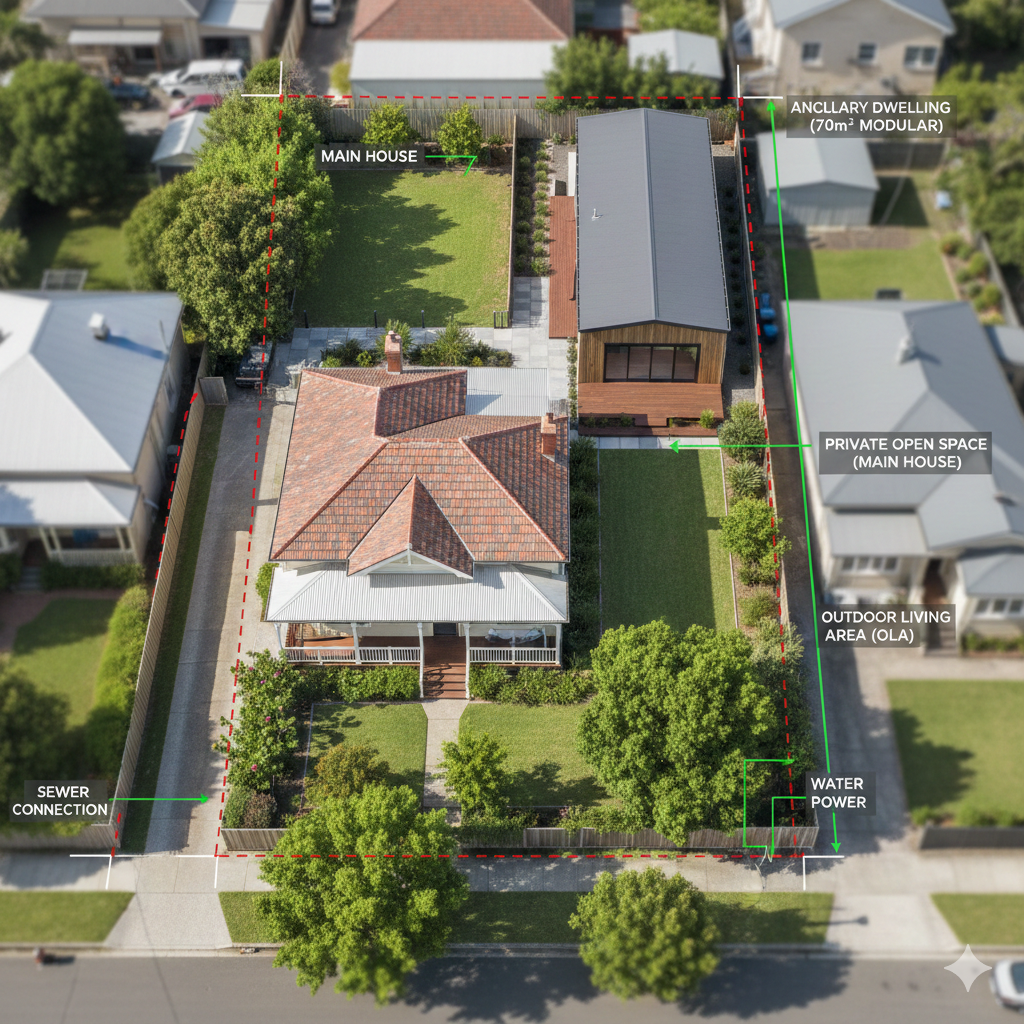
Retain the main house
Build a compliant modular dwelling at the rear
Instead of one income-producing asset, you now have two functional structures on a single title.
You’ve increased land utilisation without buying more land.
In high-cost environments like Perth, land is the appreciating component.
Building smarter on land you already own is leverage without acquisition risk.
“The “Swap & Pay Off” Strategy ”.
3️⃣ The “Swap & Pay Off” Strategy
This is where it becomes powerful.
Step 1:
Move into the new modular home at the back.
Step 2:
Rent out the larger main house at the front.
Example scenario:
Main house rental income: $600 per week
Modular loan repayment: ~$380 per week
Difference: $220 positive buffer per week.
That buffer can:
Accelerate loan repayment
Build savings
Cover insurance and maintenance
Reduce financial stress
Instead of stretching yourself thin to afford a bigger loan…
Your existing property begins servicing your new debt.
That is financial engineering.
4️⃣ Manufactured Equity – Creating Value Instead of Waiting for It
Most people rely on market appreciation to grow equity.
But appreciation is passive and unpredictable.
Adding a legally approved secondary dwelling (granny flat or modular home) can immediately increase property value.
Example:
Current property value: $650,000
After adding compliant modular dwelling: potentially $780,000 – $820,000 (location dependent)
You have not waited five years.
You have created equity through development.
This is known as:
👉 Manufactured Equity
That equity can later be used to:
Refinance
Fund further investments
Consolidate debt
Expand portfolio
Instead of saving for years, you unlock value through structure.
5️⃣ Small Loan Advantage for HECS & Car Debt Borrowers
Many middle-income earners feel financially trapped because:
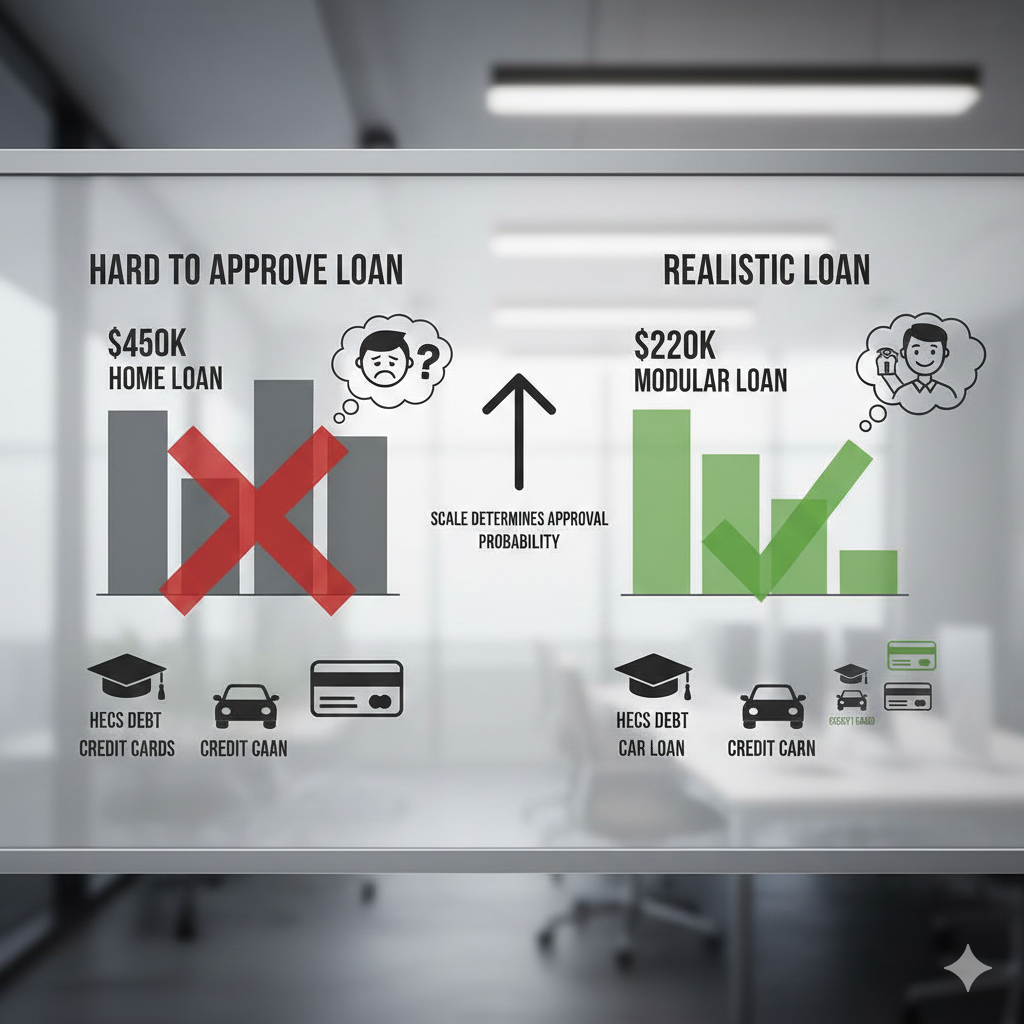
HECS repayments reduce serviceability
Car loans limit borrowing capacity
Credit card limits are counted against them
Large construction loans become nearly impossible.
But smaller loans:
Lower lender risk
Simpler approval pathway
Less financial stress
Higher probability of approval
A $220k modular loan is far more achievable than a $450k construction facility.
For many WA households, scale determines approval.
6️⃣ Cash Flow Preservation in a High-Interest Environment
Interest rates in Australia remain elevated compared to pre-2020 levels.
Long construction timelines create exposure to:
Rate fluctuations
Material cost increases
Builder delays
Variation charges
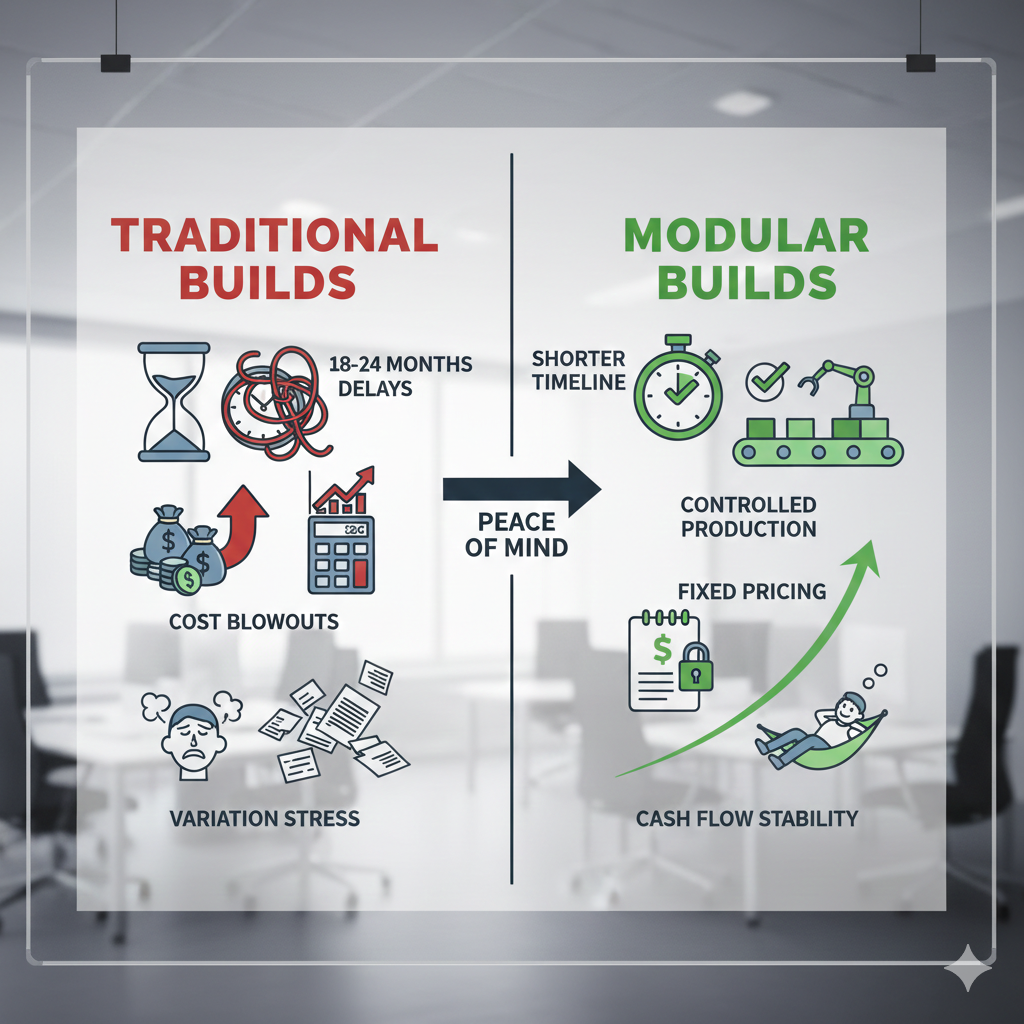
Traditional brick builds often experience:
Budget blowouts
Delays of 18–24 months
Temporary rental accommodation costs
Modular construction mitigates:
✔ Extended exposure
✔ Escalating holding costs
✔ Unpredictable site risks
Cash flow stability matters more than ever.
Preserving liquidity allows you to:
Handle emergencies
Maintain investment flexibility
Avoid high-interest personal debt
7️⃣ Let the Front House Fund the Future
Once the modular loan is paid off, the front house rental income becomes pure strategic leverage.
You now have:
A debt-reduced asset
Rental income
Increased equity
This income can be allocated to:
A rebuild of the main house
A second investment property
Portfolio diversification
This is the long-game property play.
You build behind first — then scale forward.
8️⃣ Avoiding Capital Disruption & Hidden Costs
Demolishing a structurally sound home can trigger:
Demolition fees
Site clearing
Council permits
Utility reconnections
Unexpected soil conditions
Maintaining the existing structure:
✔ Preserves asset history
✔ Avoids unnecessary destruction
✔ Reduces upfront capital risk
Strategic expansion is safer than total replacement.
9️⃣ Increased Borrowing Capacity in the Future
Once rental income is established, lenders may include a portion of rental earnings in your serviceability assessment.
This means:
Higher borrowing ceiling
Greater investment opportunities
Improved loan structure options
Your modular investment improves your financial profile.
It doesn’t restrict it.
🔟 Fixed Price Security – The Psychological Advantage
One of the greatest fears in current WA construction is cost variation.
Many households have experienced:
Builders requesting additional funds
Projects pausing mid-construction
Contracts escalating
A fixed price modular contract reduces:
✔ Budget uncertainty
✔ Mid-build financial shock
✔ Psychological stress
Predictability equals confidence.
Confidence supports smarter long-term planning.
Why This Strategy Works in Western Australia
WA property remains relatively affordable compared to eastern states — but construction costs have surged.
Land-rich, cash-tight homeowners are common.
The 4x income rule limits expansion — but not innovation.
Building modular instead of brick aligns with:
Current lending policies
Borrowing power realities
Rental demand in Perth
Granny flat investment trends
It is not a shortcut.
It is structured leverage.